Custom bags for packaging that balance branding, cost, and compliance
What custom bags for packaging should decide before design
Custom bags for packaging are more than printed carriers with a logo. A useful bag specification links the product’s size, weight, shelf-life needs, sales channel, customer experience, and likely disposal route. In many cases, the strongest design is the one that does the required job with the least avoidable material, clear labeling, and no unsupported claims. For a broader view of formats across custom packaging, bags should be treated as a strategic packaging choice, not a last-minute branding surface.
That matters because bag decisions now sit between marketing, logistics, waste policy, and consumer trust. A premium-looking bag can still fail if it tears in fulfillment, uses a structure that is difficult to recover, or makes environmental claims the brand cannot substantiate.

Match the bag format to the job
The first decision is format. Many packaging mistakes start when buyers choose a bag by appearance before defining what it must protect, carry, seal, or communicate. A lightweight retail bag, an e-commerce mailer, a stand-up pouch, and a protective liner may all be custom bags, but they solve different problems.
Retail shopping and merchandise bags
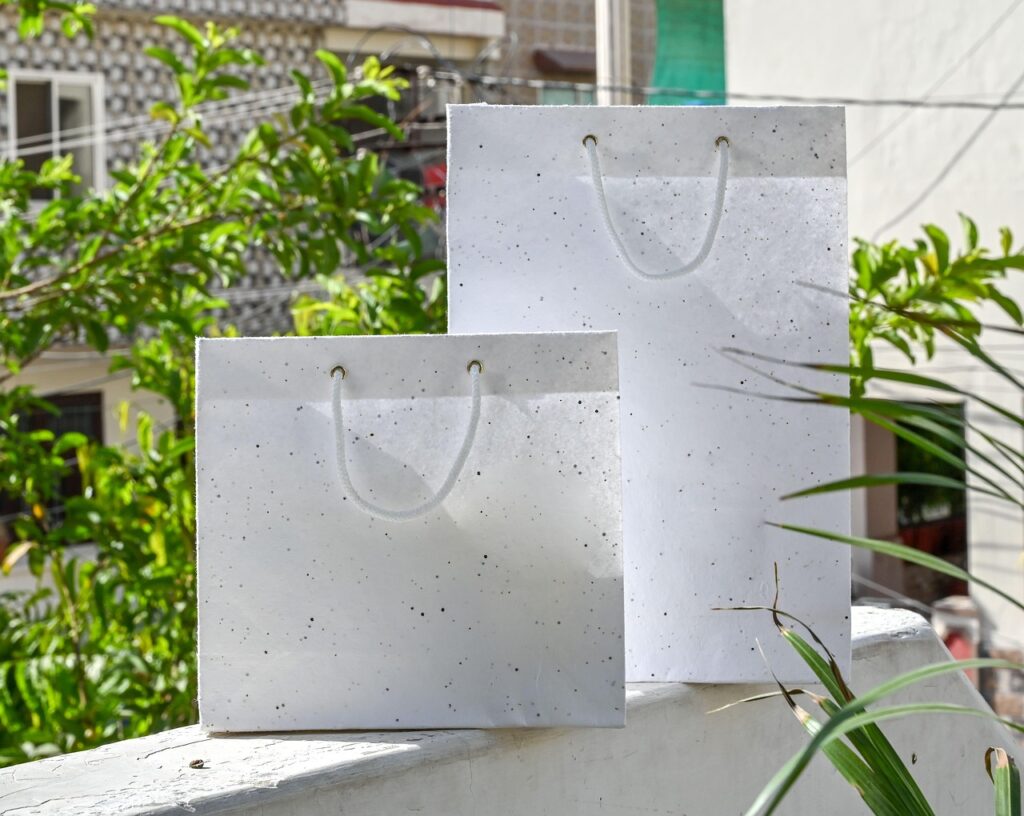
Retail bags are designed for hand-carry convenience and brand visibility. Key variables include handle type, bottom gusset, side gusset, thickness, print coverage, and whether the bag needs to stand upright at checkout. Paper bags can support a tactile, gift-like presentation. Plastic film bags can offer moisture resistance and compact storage. Neither material is automatically better in every case; the right choice depends on load, reuse expectations, local rules, and how customers are likely to dispose of the bag.
E-commerce mailer bags
Mailer bags are judged by fulfillment speed, seal strength, tamper evidence, weather resistance, return features, and dimensional efficiency. An oversized mailer can increase material use and shipping volume. An underspecified one can split during transit and create replacement costs. For apparel, accessories, and other non-fragile items, flexible mailers can reduce empty space compared with rigid cartons, but the design still needs to account for barcode placement, carrier labels, and the opening experience.
Pouches and product-contact bags
Pouch-style bags are closer to primary packaging. They may need barrier properties against moisture, oxygen, grease, aroma, or light. Coffee, snacks, powders, personal care refills, pet products, and small hardware can all require different structures. In this category, the buyer should not start with the artwork file alone. The specification should identify the filling method, seal area, shelf-life target, closure type, food-contact requirements if relevant, and whether the pack must hang, stand, or lie flat.
Liners, inner bags, and protective sleeves
Inner bags and liners often receive less design attention, but they can be critical for dust control, moisture protection, contamination reduction, or multi-pack organization. In industrial and light manufacturing contexts, these bags may not need complex graphics. They do need accurate sizing, material compatibility, and consistent production tolerances.
Material choices are trade-offs, not slogans
The Flexible Packaging Association describes flexible packaging as products made from paper, plastic, film, foil, or combinations of these materials, including bags, pouches, liners, wraps, labels, and rollstock. That broad definition is useful because it shows why the word bag is not specific enough for procurement. A bag may be recyclable paper, mono-material plastic film, multilayer barrier laminate, compostable plastic, woven material, or a hybrid construction.
U.S. EPA materials data also treats containers and packaging as a distinct municipal solid waste category, which reinforces why packaging format and end-of-life assumptions deserve attention. For custom bags, the practical question is not which material sounds most sustainable in isolation. It is which structure can meet the product’s functional needs while avoiding unnecessary complexity.
| Material direction | Where it can work | What to check before ordering |
|---|---|---|
| Paper bags | Retail, gift, dry goods, premium presentation | Strength when wet, handle durability, coating, print coverage, recycled content claims |
| Mono-material PE or PP film | Mailers, apparel, dry goods, light protective packaging | Thickness, seal strength, store drop-off or local recovery options, ink and label compatibility |
| Recycled-content plastic film | Retail and shipping bags where performance is proven | Verified recycled content, food-contact limitations, appearance variation, supply consistency |
| Compostable plastic | Selected organic-waste or food-service contexts with access to composting infrastructure | Applicable standard, certification evidence, local acceptance, clear disposal instructions |
| Multilayer barrier laminate | Products needing shelf-life protection or aroma, oxygen, grease, or moisture barriers | Recovery limitations, necessary barrier level, alternative mono-material structures, claim restrictions |
Barrier performance can be a valid reason to use a more complex material. If a pouch prevents spoilage or leakage, its total value may be greater than a simpler bag that causes product waste. The key is to document the reason for complexity instead of treating every added layer, coating, window, or finish as a visual upgrade.
Sustainability claims need evidence
Environmental language on custom bags should be precise. The U.S. Federal Trade Commission’s Green Guides advise marketers to avoid broad, unqualified environmental benefit claims such as eco-friendly or green when those claims cannot be clearly substantiated. In practical terms, a custom bag should not rely on a leaf icon, earthy color palette, or vague phrase to imply benefits that the specification does not prove.
Compostable claims require special care. ASTM D6400 is a standard specification for labeling plastics designed to be aerobically composted in municipal or industrial composting facilities. That does not mean every compostable-looking bag will be accepted by every local composting program. Buyers should ask for certification evidence, identify the intended composting environment, and avoid implying home compostability unless that specific claim is supported.
Recyclability claims also depend on structure and access. A mono-material film may be technically recyclable in some systems, but labels, adhesives, metallic inks, heavy print coverage, coatings, or contamination can reduce practical recovery. For paper bags, coatings and plastic windows may affect repulpability. For laminated pouches, strong product protection may come with limited recycling options. Clear disposal instructions are more credible than broad claims that oversimplify the end-of-life path.
- Use specific terms such as made with verified post-consumer recycled content only when documentation supports the percentage.
- Do not combine compostable, biodegradable, recyclable, and reusable language unless each claim is separately accurate and understandable.
- Make the claim apply to the correct item: the bag, the handle, the label, the closure, or the full packaging system.
- Review local and target-market rules before printing environmental claims at scale.
Design details that change performance
Artwork matters, but bag performance often depends on less visible details. Size is the most important starting point. A bag should fit the product with enough clearance for packing and sealing, but not so much that it increases void space or looks underfilled. Gussets can improve capacity and presentation, yet they may add material and affect stacking. Seals must match the filling process, product weight, and handling conditions.
Thickness should be specified by function rather than habit. Thicker is not always better if it adds cost without improving failure rates. Thinner is not better if it tears, stretches, punctures, or creates customer complaints. For film bags, buyers should ask how thickness, resin blend, recycled content, and seal temperature interact. For paper bags, basis weight, fiber quality, lamination, and handle reinforcement can change real-world strength.
Printing can also affect appearance and recovery. Heavy ink coverage may be visually strong, but it can complicate quality control, increase drying or curing demands, and influence recyclability discussions. Matte finishes, metallic effects, windows, spot coatings, and soft-touch surfaces should be treated as functional decisions, not only style choices. The same applies to closures: zipper, adhesive strip, tin tie, drawstring, heat seal, and resealable tape each changes cost, usability, and potential disposal guidance.
Small communication choices can reduce friction. A clear front panel can identify the product and brand. A side or back panel can carry barcode, batch, safety, disposal, and compliance information. If space is limited, a QR code can connect to instructions, but it should not replace required on-pack information. See also: Food Packaging.
Cost, minimum order quantity, and supplier questions
The cost of custom bags is driven by more than material weight. Tooling, plate or cylinder requirements, number of print colors, order quantity, structure complexity, closures, testing, certification documentation, and lead time all matter. A low unit price can be misleading if the design creates excess inventory, slow changeovers, or packaging failures.
Minimum order quantity is especially important for seasonal campaigns, new product launches, and regional compliance variations. If a brand prints too much packaging before validating demand or legal language, it may be forced to use outdated bags or write off inventory. A safer approach is to separate stable elements from changeable ones. For example, a generic branded bag with a variable label may be better for early-stage products than a fully printed structure that includes claims, barcodes, and regulatory text likely to change.
Before ordering, buyers should ask suppliers practical questions rather than relying only on a sample photo:
- What product weight, dimensions, and handling conditions was this structure designed to support?
- Which parts of the bag are custom: size, material, handle, closure, print, finish, or all of them?
- Are recycled-content, compostable, or recyclable claims supported by documentation?
- Will inks, adhesives, labels, zippers, or windows affect the intended end-of-life route?
- What tests are available for drop, puncture, seal strength, rub resistance, or moisture exposure?
- How will the bag be packed, stored, shipped, and used on the filling line?
- Can the design be revised without scrapping large quantities of inventory?
Regulatory pressure is changing bag specifications
Packaging rules are moving from broad waste goals toward more specific design, labeling, producer responsibility, and recyclability expectations. For companies selling across regions, custom bags should be specified with the destination market in mind, not only the production market.
In the European Union, Regulation (EU) 2025/40 on packaging and packaging waste entered into force on February 11, 2025, and generally began applying from August 12, 2026. The regulation is intended to harmonize packaging rules, reduce waste, increase recyclability, and support recycled plastic use in packaging. For bag buyers, the practical lesson is to watch material minimization, recyclability, labeling, and recycled-content requirements before locking in long packaging runs.
In California, SB 54 created an extended producer responsibility framework for single-use packaging and plastic food service ware. CalRecycle’s 2026 materials explain goals that include making covered packaging recyclable or compostable by 2032, increasing recycling rates, and reducing plastic packaging. Brands that sell into California should review whether a custom bag falls within covered material categories and whether any recyclability or compostability claim aligns with state determinations.
These examples do not mean every small buyer needs a legal department for every bag order. They do mean that printed claims and material choices should not be treated as permanent. A good specification leaves room for updated labeling, regional versions, and supplier documentation.
A practical specification checklist
A clear brief helps designers, converters, and buyers discuss the same packaging outcome. For custom bags, the brief should include both visual and technical requirements.
- Define the product. Record size, weight, shape, sharp edges, moisture sensitivity, oil content, odor, shelf-life needs, and whether the bag touches the product directly.
- Define the channel. Retail shelf, checkout, warehouse picking, parcel delivery, food service, event giveaway, and industrial packing each have different stress points.
- Choose the format. Decide whether the bag needs handles, gussets, a flat bottom, a zipper, adhesive seal, hang hole, venting, or tamper-evident feature.
- Select material by function. Compare paper, film, laminate, recycled-content material, or compostable material against strength, barrier, print, and end-of-life needs.
- Control the claim language. Write only claims that can be supported by standards, supplier documentation, and market-specific rules.
- Test before scaling. Review filled samples, not empty samples only. Test packing speed, seal quality, transport, customer opening, and disposal messaging.
- Plan version control. Keep artwork, compliance text, barcodes, and disposal icons in a controlled file system so updates do not create mixed inventory.
The best custom bag is rarely the most decorated one. It is the bag that protects the product, communicates clearly, supports efficient handling, and avoids claims the brand cannot defend. That balance is where packaging design becomes more than a surface treatment.
Frequently asked questions
Are paper custom bags always more sustainable than plastic bags?
No. Paper may be a good choice for retail presentation and certain recycling streams, but it can be heavier, less moisture-resistant, and may require coatings or reinforcement. Plastic film can be lightweight and protective, but recovery may be limited depending on structure and local collection. The better choice depends on use, reuse, transport, and disposal context.
What is the difference between recyclable and compostable bags?
Recyclable bags are intended to be collected and processed into material for new products, where the local system accepts that material and form. Compostable bags are intended to break down under defined composting conditions. A compostable claim should be backed by an applicable standard or certification and should match the composting infrastructure available to the intended users.
How early should packaging claims be reviewed?
Claims should be reviewed before artwork approval, not after production. Words such as recycled, recyclable, compostable, biodegradable, plastic-free, and eco-friendly can create compliance and trust risks if they are vague or unsupported. Early review helps prevent expensive redesigns and inventory waste.
What makes custom packaging bags cost more?
Cost increases can come from custom size, special materials, high print coverage, multiple colors, closures, handles, barrier layers, certifications, testing, tooling, small order quantities, and urgent lead times. Buyers should compare total landed and operational cost, not only unit price.
Can one custom bag design work in every market?
Sometimes, but not always. Different regions may have different labeling rules, bag restrictions, producer responsibility obligations, or recovery systems. A modular design with stable branding and adjustable compliance panels can be safer for brands selling across multiple markets.